
Gutter Heat Cable and Roof De-Icing in Southern Maine: What It Costs and How the 2026 Code Requires It to Be Wired
Synopsis
Gutter heat cable can help keep a drainage path open when snowmelt refreezes along the roof edge. In Southern Maine, a professionally installed roof de-icing system may cost about $800–$2,750 for a typical home, with complicated projects costing more. A new fixed system started on or after July 1, 2026 must follow Maine’s adopted 2026 National Electrical Code (NEC) and local requirements. NEC Article 426 addresses fixed outdoor de-icing equipment, including required ground-fault protection of equipment.
Heat cable can help manage ice, but it does not fix the building conditions that cause ice dams. Better attic air sealing, insulation, and roof ventilation are important parts of a lasting solution.
Why Southern Maine homes get ice dams
Snow on a roof can melt when heat escapes from the home into the attic and warms the roof deck. Meltwater flows toward the colder eaves, where it can refreeze. As ice builds up, it may block drainage and allow water to back up under shingles.
Southern Maine’s snow and freeze-thaw cycles can make this a recurring concern. Long eaves and exposed roof edges on coastal homes in Saco, Biddeford, Old Orchard Beach, and Kennebunk can also leave gutters and downspouts vulnerable to freezing.
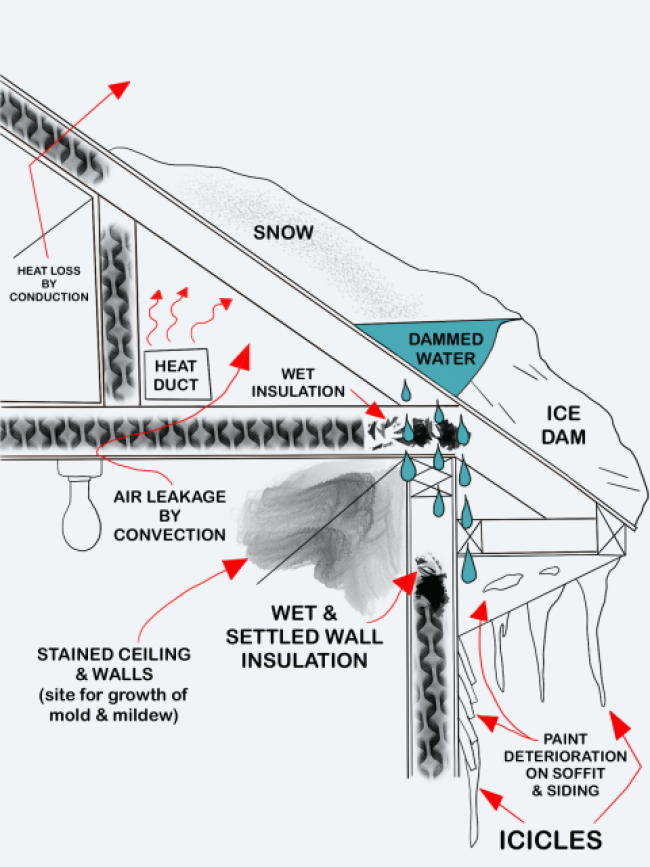
The U.S. Department of Energy’s Building America Solution Center guidance recommends air sealing the ceiling plane, thoroughly insulating the attic, and ventilating the roof. De-icing cable can help maintain a route for meltwater to drain, but it is not a substitute for addressing heat loss.
How roof and gutter heat cable works
Roof de-icing cable is installed outdoors along selected roof edges, gutters, and downspouts. When designed as a continuous route, it can help melt a narrow channel through ice so water can move off the roof and out through the drainage system. It is not intended to clear snow from the whole roof or reduce roof snow load.
A common layout includes:
A zig-zag pattern along the lower roof edge, extending up the roof above the exterior wall line.
A run through the gutter to help keep drainage open.
Cable down the downspout to its discharge point.
Suitable clips and attachments for the roof and gutter materials.
Cable length depends on roof pitch, eave overhang, gutter depth and width, valleys, and downspouts. For example, a manufacturer’s design guide shows that a zig-zag layout can require several feet of cable for each foot of roof edge. Measure the actual roof and follow the selected system’s design instructions rather than estimating cable from gutter length alone.

Self-regulating or constant-wattage cable?
Self-regulating cable adjusts its heat output as surrounding temperatures change. It is often a practical choice for residential roof and gutter work. Some listed products are designed to tolerate contact or overlap, but never assume that is allowed: follow the cable manufacturer’s instructions.
Constant-wattage cable produces a consistent output and must not overlap unless its instructions specifically say otherwise. In typical use, overlapping constant-wattage cable can create excessive heat.
Both types need the correct cable length, attachments, connections, controls, and electrical protection. A thermostat or temperature-and-moisture controller can reduce unnecessary run time. Check the product’s watts-per-foot rating to understand its energy draw: for example, 100 feet of cable rated at 12 watts per foot can draw about 1,200 watts while operating at that output. Actual use depends on the product, weather, and controls.
What does gutter heat cable cost in Southern Maine?
For 2026 budgeting, national benchmarks put professional installation around $13–$26 per linear foot. Self-regulating cable alone may run about $5–$17 per foot, depending on the product, and the cable for an average single-family home can run $1,700–$5,750 in materials before labor, controls and electrical work. Actual quotes vary with roof access, cable length, controls, electrical work, and roof condition. See Warmup’s 2026 roof and gutter heating system cost guide for national cost context.
Using a 25% planning uplift for Southern Maine, approximate ranges are:
Project item | Southern Maine planning estimate |
Professionally installed system | About $16–$33 per linear foot |
Self-regulating cable material | About $3–$21 per foot |
Typical single-family project | About $800–$2,750 |
Broader project range | About $625–$5,750 |
Dedicated circuit or outdoor electrical work | About $300–$650 |
These are planning figures, not a quote. Ask whether a per-foot figure is based on cable length or roof-edge length; a zig-zag layout can use much more cable than the length of the eave. The circuit estimate may be additional if electrical work is not included in the system price. Difficult roof access, long runs, extra circuits, controller choices, panel capacity, and repairs can all change the total.
What the 2026 electrical code requires
Maine adopted the 2026 NEC through the Electricians’ Examining Board’s Chapter 120. Installations commencing on or after July 1, 2026 must comply with that code, Maine amendments, and applicable local requirements. See the adopted Chapter 120 rule PDF.
For roof and gutter de-icing, the relevant section is NEC Article 426, which covers fixed outdoor electric de-icing and snow-melting equipment. NEC 426.28 requires ground-fault protection of equipment (GFPE) for this equipment. The protection level must follow the equipment listing and manufacturer’s requirements. Some products use 30 mA GFPE, but 30 mA is not a universal trip level specified by the code. GFPE is also not the same thing as a Class A personnel GFCI.
A receptacle-supplied system may also be subject to outdoor GFCI requirements. Those requirements do not replace the equipment-level protection required for fixed de-icing equipment. A licensed electrician can confirm the correct circuit, protection, and local permit requirements for your installation.

Long cable runs should not be connected casually to plug-in sets or extension cords. The load, cable run limits, circuit sizing, connections, and protection all need to match the selected system. Have the system tested in cold weather before the first freeze, and use the manufacturer’s instructions for operation and maintenance.
Is heat cable the whole ice-dam solution?
No. Heat cable can help maintain drainage where ice tends to collect, but it treats the symptom. The Department of Energy’s ice-dam guidance points to air sealing, insulation, and roof ventilation as important ways to reduce the conditions that contribute to ice dams.
If you’re looking for an electrician in Saco, Maine, or need an ice dam electrician in Maine, we can help assess the electrical requirements and discuss practical options. Learn more about our general electrical service or contact Downeast Electrical Services.
Frequently asked questions
Does gutter heat cable use a lot of electricity?
It depends on the cable’s watts per foot, total length, weather, and how long the system runs. A controller can limit operation to conditions when de-icing is useful. Downeast can help estimate system load and discuss suitable controls.
What size cable do I need for my gutters?
There is no one cable length for every home. Roof edges, overhangs, gutter dimensions, valleys, and downspouts determine the design. Downeast can help assess the layout and electrical needs for your roof and gutters.
Is heat cable safe on a metal roof?
It can be suitable for some metal roofs when the cable and attachment method are approved for that application. Follow the roof and cable manufacturers’ instructions. Downeast can help review the electrical requirements and coordinate an appropriate installation approach.
Can I plug heat cable into an extension cord?
No. Do not use an extension cord as a substitute for a correctly designed supply. Downeast can help determine the proper circuit and outdoor connection requirements for your system.
Why does my heat cable trip the breaker?
Possible causes include a damaged cable, moisture in a connection, an unsuitable device, or a circuit that is not correctly sized. Do not bypass protection or keep resetting a breaker that trips. Downeast can help troubleshoot the circuit and equipment safely.
Does heat cable prevent ice dams completely?
No. It may help keep drainage paths open, but it does not correct attic heat loss or guarantee an ice-dam-free roof. Downeast can help with the electrical side while you address insulation, air sealing, and ventilation.
When should I turn the cable on?
Follow the system manufacturer’s operating instructions. Automatic controls can activate the system when temperature and moisture conditions call for it. Downeast can help select and wire controls suited to the installation.
How much does installation cost in Maine?
A typical Southern Maine planning range is about $800–$2,750, with complex projects costing more. Circuit work may be extra if it is not included in the estimate. Downeast can review the project and provide guidance on the electrical scope.
Do I need a permit?
Permit requirements depend on the municipality and the details of the work. Check with your local code office before installation. Downeast can help clarify electrical requirements and coordinate permit questions for your project.
What is the difference between self-regulating and constant-wattage cable?
Self-regulating cable adjusts output as conditions change; constant-wattage cable delivers consistent output. Their use and installation rules differ, including overlap restrictions. Downeast can help check that the cable and electrical design are compatible.
How long does heat cable last?
Service life depends on the product, installation, weather exposure, and maintenance. Inspect it as directed by the manufacturer and replace damaged components rather than attempting makeshift repairs. Downeast can help assess electrical issues and replacement needs.
Does Downeast install roof de-icing cable?
Contact us to discuss your roof, project scope, and electrical requirements. Downeast Electrical Services serves residential and commercial customers in Southern Maine and can help evaluate the electrical work involved.
Sources
A properly designed roof de-icing system can help keep meltwater moving, but the best long-term plan also addresses attic air leakage, insulation, and ventilation. If you have questions about a gutter heat cable project in Saco, Biddeford, Scarborough, Portland, or nearby Southern Maine communities, Downeast Electrical Services is here to help. Stay tuned for more practical electrical guidance from our team.
Comments